
That's where 3D printing earns its place in advertising. It can produce custom props, product replicas, mascots, oversized logos, prototypes, set pieces, point-of-purchase displays, and large installations, often working alongside traditional fabrication methods rather than replacing them.
This article covers where 3D printing fits into creative campaigns, how to plan and produce a physical asset, what finishing and safety actually require, and how to judge whether the finished piece earns its place in the budget.
Key Takeaways
- Custom geometries, character details, and branded shapes are achievable without mass-production tooling or standardized molds.
- Printed parts almost always feed into a larger workflow: modeling, fabrication, painting, lighting, and installation.
- Design choices should match the venue, audience interaction, scale, transport needs, and brand guidelines.
- IP permissions, venue rules, safety requirements, and storage plans need settling before fabrication starts.
How 3D Printing Supports Advertising Props and Brand Campaigns
A flat ad tells people about a product. A three-dimensional object lets them judge its scale, see its texture, and stand next to it for a photo. That difference matters when a campaign needs a focal point rather than another image in a feed.
Built for Customization, Not Mass Production
Because the object starts as a digital file, unusual geometries stop being a production headache. Studios can build:
- Branded details and logo work that would be slow to sculpt by hand
- Character features matched precisely to approved artwork
- Product replicas scaled up or down for different venues
- Modular components that ship separately and assemble on-site
- Limited-edition pieces made once, not in batches
Faster Iteration, Fewer Surprises
A digital model can be reviewed, adjusted, and reprinted before anyone commits to the final campaign piece. That's a real advantage over carving a one-off by hand and hoping the proportions read correctly at full scale.
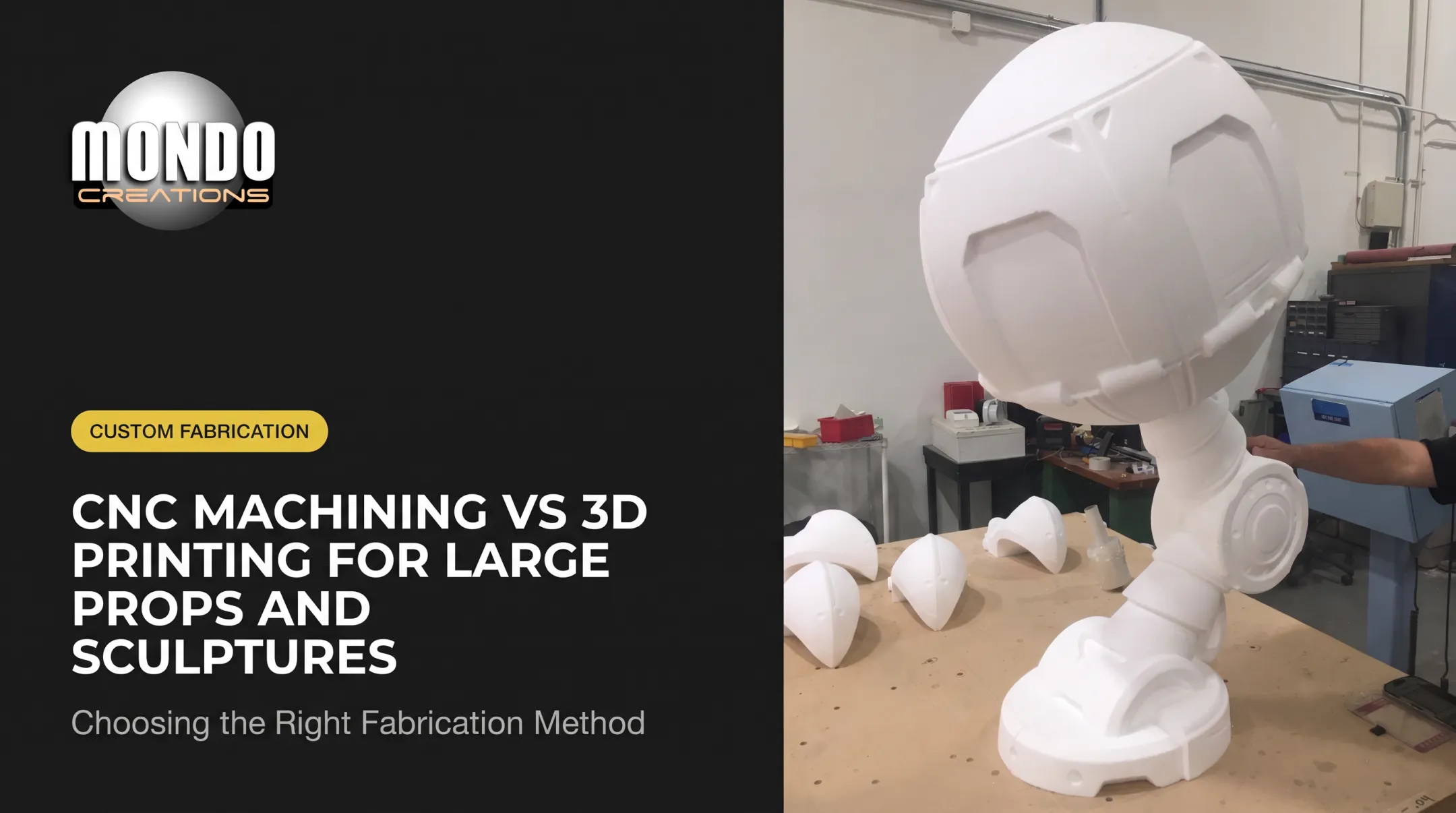
Compared with conventional fabrication, digital methods generally offer more design freedom for complex shapes, suit low-volume or one-off production better than tooling-heavy methods, and allow faster proportion checks. They're not automatically cheaper or faster for every job. Large installations often still rely on foam, CNC shaping, and hand finishing for structural reasons.
Giving People a Reason to Engage
A prop that just looks interesting isn't enough. The best ones invite action: a photo op, a touchable demo, an interactive display. In EventTrack's 2026 benchmark study, 59% of surveyed attendees said a live brand experience made them feel more positive about the brand, and 61% said it made them more likely to buy. These are self-reported attitudes across live experiences generally, not a measurement of any single prop, but they point to why brands keep investing in physical moments.
One documented case: fabricator SoonSer built 11 oversized resin sandals for a Crocs retail promotion, each roughly 1.2 meters tall, in about three days of printing followed by four days of finishing and assembly, according to SoonSer's case study. The display drew attention precisely because the scale was impossible to achieve with a standard retail fixture.

The Best Applications for 3D-Printed Advertising Props
Not every campaign object serves the same purpose. The right application depends on the audience, the venue, and the action you want people to take afterward.
Storefronts, Retail, and Point-of-Purchase
Dimensional logos, oversized product replicas, character figures, and themed window scenes work well at close range, where shoppers have time to notice detail. Illuminated elements and modular displays that can be swapped between seasons extend their shelf life.
Outdoor Stunts and Public Installations
Large product replicas and branded street installations need more planning: anchoring against wind, visibility from a distance, public safety, and local venue approval. A piece that looks great on a desktop render can become a liability if it's not engineered for outdoor exposure.
Trade Shows, Festivals, and Pop-Ups
Custom booth features, scaled prototypes, selfie points, and branded trophies give visitors something to talk about and photograph. These pieces tend to travel, so weight and breakdown matter as much as the design itself.
Film, TV, and Entertainment Campaigns
Character sculptures, franchise-themed environments, and promotional displays usually have to match approved digital assets exactly. There's little room for creative drift once a studio or licensor signs off on a design.
Branded Hospitality and Themed Environments
Restaurants, attractions, and sports venues use mascots, scenic installations, and dimensional signage to build a consistent setting. Sculptural elements, metallic finishes, and themed murals can turn a standard dining room into a branded environment that guests recognize immediately.
Product Launches and Prototypes
Different models answer different questions:
| Model Type | What It Shows Audiences |
|---|---|
| Looks-like model | Final appearance and finish |
| Scaled model | Proportions at a reduced or exaggerated size |
| Cutaway model | Internal structure or mechanism |
| Functional prototype | How the product actually works |
Quick decision guide: oversized displays grab attention, cutaways and prototypes educate, photo-ready pieces drive participation, and character or themed scenes carry brand storytelling. Pick the asset based on the job it needs to do, not just how striking it looks.
How to Plan and Produce a 3D-Printed Campaign Asset
A strong prop starts long before anyone opens a modeling program.
Define the Brief Before You Model Anything
Nail down the audience, message, placement, viewing distance, interaction level, dimensions, delivery date, budget range, and whether the piece needs to survive multiple events. Skipping this step is the fastest way to end up with a beautiful object that doesn't fit the booth.
Once the concept is approved, the production-ready model needs to account for proportions, assembly breaks, attachment points, internal supports, and space for lighting or electronics if the piece needs them.
The Approval Cycle: From Sketch to Sign-Off
Most projects move through concept sketches, a digital 3D model, a scale prototype or sample finish, client sign-off, final fabrication, quality review, and installation. Build in time for at least one revision round. Late brand approvals, a revised logo, or a last-minute venue change can all push back a delivery date, so flag those risks with the client early rather than after fabrication starts.

Materials and Finishing: What Makes It Look Right
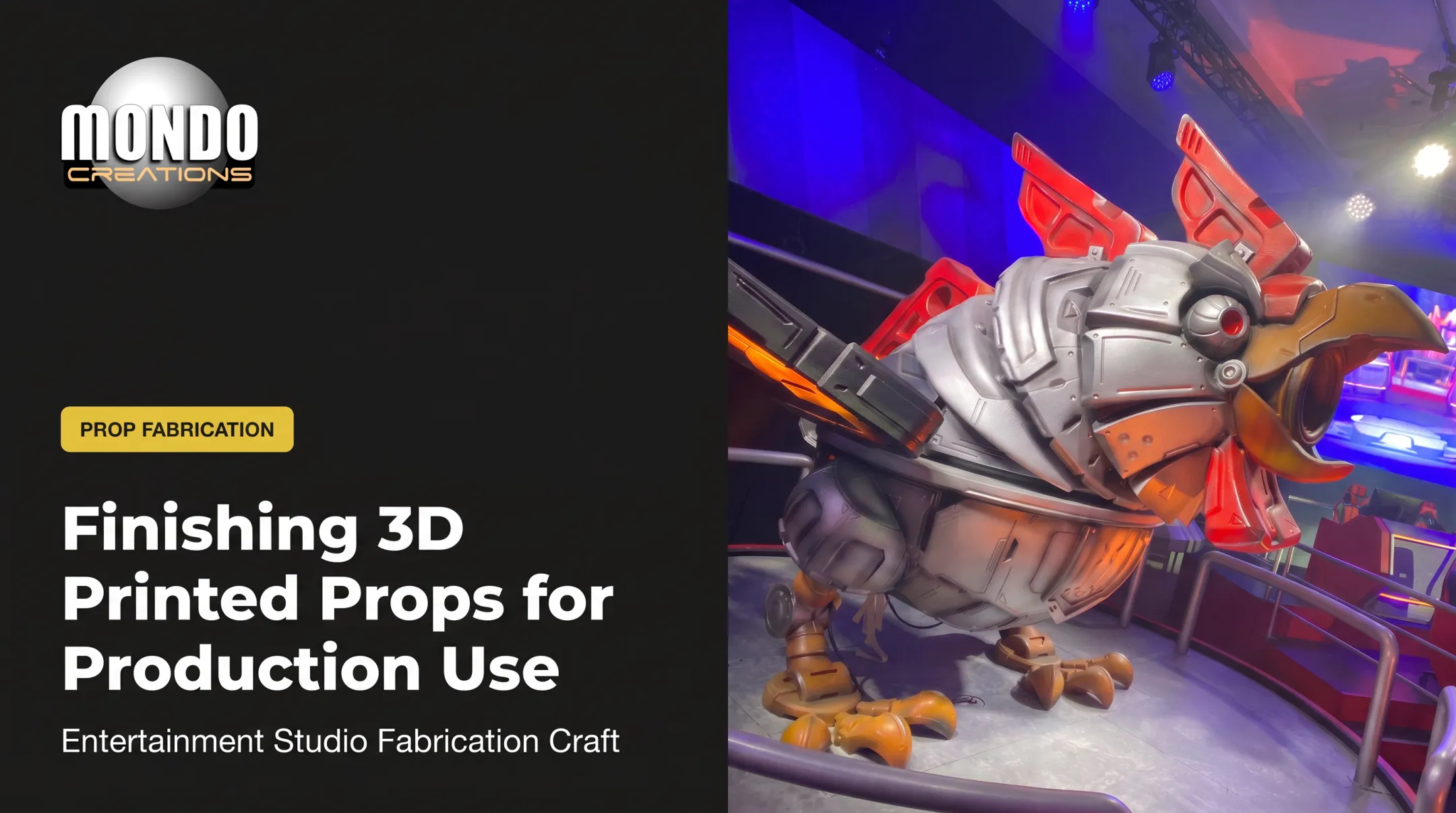
The visible final prop often combines 3D-printed parts with foam, resin, plaster, bronze, paint, and hardware. Post-processing is where a raw print becomes a finished piece:
- Sanding and filling to smooth seams
- Priming and painting for color accuracy
- Clear coating or texturing for the final look
- Assembly and quality inspection before shipping
Heinemann's roughly 13-foot dragon installation at Sydney Airport, for example, was printed in about two days and then smoothed and gold-finished by hand, a reminder that printing is one stage, not the whole job.
Safety, Compliance, and Transport Logistics
Structural stability, safe edges, load limits, and electrical integration all need checking against the specific venue, not a generic rulebook. Accessibility requirements, including the 2010 ADA Standards for Accessible Design, can affect where a display can sit relative to walkways and protruding objects. Fire codes, outdoor exposure, and local permits vary by city and event type, so check those requirements separately for each installation rather than assuming one clearance covers everything.
For pieces that travel, modular construction, protective packing, wheeled platforms, and documented installation instructions make the difference between a smooth reinstall and a damaged centerpiece.
Where Mondo Creations Fits In
Mondo Creations supports this workflow end-to-end: 3D modeling and custom sculpture, foam fabrication, CNC-assisted shaping, painting and metallic finishing, and installation-ready delivery.
Client Prep Checklist
Before fabrication begins, have ready:
- 3D model files (.stp, .step, .fbx, .dwg, .dxf, .igs, .stl, .obj, or .3dm) or 2D drawings and reference images
- Brand guidelines and approved colors
- Licensing documentation for any third-party characters or marks
- Venue measurements and access details
- Installation windows and on-site contact information
Examples of 3D Printing in Brand Campaigns and How to Measure Results
A handful of documented campaigns show what dimensional fabrication can do. Most reported figures describe the object or production schedule, not an independently audited lift in sales or awareness.
| Brand | Asset | What's Documented |
|---|---|---|
| L'Occitane | ~14-foot printed shower-oil bottle, New York | Size and placement confirmed; no independently measured visitor or sales count reported |
| Heinemann | ~4-metre gold-finished dragon, Sydney Airport | Printed in roughly two days, then hand-finished; vendor reports crowds, no audited footfall |
| Crocs | 11 oversized resin sandals, ~1.2 m each | Three days printing, four days finishing; no verified store-traffic comparison |
| Sony Pictures Ghostbusters | Printed icons on wrapped promotional buses | 10-day production for the dimensional elements; no audited impression count |
Building a Measurement Framework That Actually Works
A striking object still needs to connect to something trackable. Before building, define:
- A baseline - what traffic, sales, or engagement look like without the campaign.
- The campaign action - visiting a booth, scanning a code, sharing a photo, trying a product.
- Online and offline signals - foot traffic, dwell time, social mentions, coupon redemptions, press coverage.
- Audience feedback - short surveys or informal interviews during the activation.
- Reuse potential - whether the piece can travel to the next event or activation.
Without this framework, even a well-built prop risks becoming a one-off expense instead of a reusable campaign asset.
Bringing a 3D-Printed Advertising Concept to Life with Mondo Creations
Mondo Creations is a custom sculpture and themed installation studio for advertising agencies, entertainment and gaming brands, television and film productions, themed restaurants, sports organisations, and event producers.
The studio's capabilities include one-of-a-kind sculptural work, character and product-focused design, 3D modelling, CNC milling, foam fabrication, painting, metallic finishes, resin and bronze work, and large-scale installation support.

To get an accurate quote, prospective clients should provide:
- 3D model files or reference drawings
- Target dimensions and intended materials or finish
- Venue details and installation requirements
- Timeline and intended use or reuse plans
If your next campaign needs a sculpture, branded environment, or installation-ready piece built from the ground up, reach out to Mondo Creations to talk through scope and timeline.
Frequently Asked Questions
What are you not allowed to 3D print?
Restrictions generally cover illegal weapons or weapon components, regulated items, and copyrighted or trademarked designs used without permission. Always verify applicable U.S. laws and intellectual property rights before fabrication.
Can 3D printing be used to make large advertising props?
Yes. Large props are typically printed or fabricated in sections, then assembled and reinforced for display. The exact approach depends on scale, weight, environment, and transport needs.
What types of advertising props can be made with 3D printing?
Common examples include product replicas, logos, mascots, characters, prototypes, dimensional signage, trophies, photo opportunities, and themed installations. The best choice depends on the campaign goal.
Are 3D-printed advertising props durable enough for events?
Durability depends on material, wall thickness, internal structure, and finishing, plus whether the piece is used indoors or outdoors. Specify expected use and handling before production begins.
How much does a 3D-printed advertising prop cost?
Pricing depends on size, design complexity, materials, finishing, assembly, transport, and timeline. Submit detailed project information, including dimensions and reference files, for an accurate quote.
How long does it take to produce a 3D-printed campaign prop?
Lead time depends on design readiness, approval rounds, scale, finishing, and installation logistics. Coordinate with your fabricator early around the campaign launch date to avoid delays.